
TOPAZ
Honey yellow. Fiery orange. Cyclamen pink. Icy blue. In warm or cool tones, topaz is a lustrous and brilliant gem.
OVERVIEW
ABOUT TOPAZ

Topaz actually has an exceptionally wide color range that, besides brown, includes various tones and saturations of blue, green, yellow, orange, red, pink, and purple. Colorless topaz is plentiful and is often treated to give it a blue color. Topaz is also pleochroic, meaning that the gem can show different colors in different crystal directions.
Topaz Description
Many consumers know topaz as simply an inexpensive blue gem. They’re surprised to learn that its blue color is hardly ever natural: It’s almost always caused by treatment. They might also be surprised to know that topaz has so many more colors to offer gem lovers, including pinks and purples that rival the finest fancy sapphires.
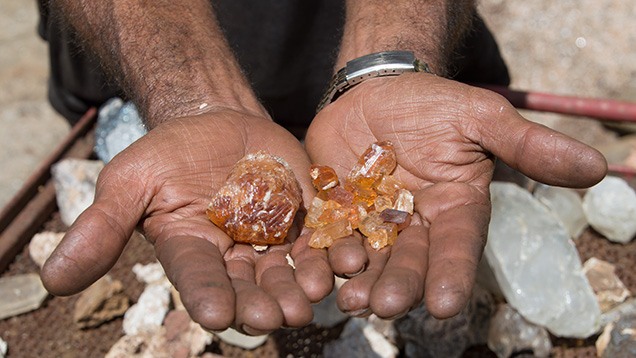
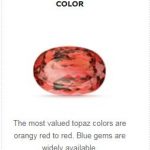
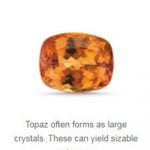
The color varieties are often identified simply by hue name—blue topaz, pink topaz, and so forth—but there are also a couple of special trade names. Imperial topaz is a medium reddish-orange to orange-red. This is one of the gem’s most expensive colors. Sherry topaz—named after the sherry wine—is a yellowish-brown or brownish yellow to orange. Stones in this color range are often called precious topaz to help distinguish them from the similarly colored but less expensive citrine and smoky quartz.
Topaz is also pleochroic, meaning that the gem can show different colors in different crystal directions.
Topaz History and Lore
Most authorities agree that the name topaz comes from Topazios, the old Greek name for a small island in the Red Sea, now called Zabargad. (The island never produced topaz, but it was once a source of peridot, which was confused with topaz before the development of modern mineralogy.) Some scholars trace the origin back to Sanskrit (an ancient language of India) and the word topas or tapaz, meaning “fire.”
The ancient Greeks believed that topaz gave them strength. In Europe during the Renaissance (the period from the 1300s to the 1600s) people thought that topaz could break magic spells and dispel anger. For centuries, many people in India have believed that topaz worn above the heart assures long life, beauty, and intelligence.
The name for imperial topaz originated in nineteenth-century Russia. At the time, the Ural Mountains were topaz’s leading source, and the pink gemstone mined there was named to honor the Russian czar. Ownership of the gem was restricted to the royal family.
Today, topaz is one of the US birthstones for November. The other is citrine quartz.
Topaz Journey
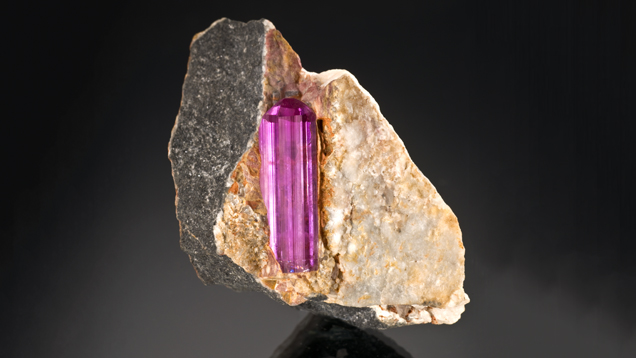
Few people outside the gem industry realize the true nature of a gemstone’s journey from the mine to the counter of a store. Whether the gem is being offered to consumers at a traditional jewelry store’s counter, an internet shopping site, or a television broadcast the journey always involves a great deal of effort. Tons of earth and countless hours of labor are needed to being a gem from mine to market.

TREATMENTS
There are a number of processes used to alter the color, apparent clarity, or improve the durability of gems.
SYNTHETICS
Some gemstones have synthetic counterparts that have essentially the same chemical, physical, and optical properties but are grown by man in a laboratory.
IMITATIONS
Any gem can be imitated—sometimes by manmade materials or by natural materials chosen by a man to impersonate a particular gem.

WHY WE LOVE THIS GEMSTONE

QUALITY FACTORS
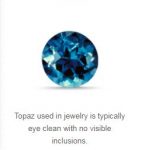
Topaz comes in a variety of colors from shades of blue to the rare reddish imperial colors.
Source: https://www.gia.edu/topaz/gem-overview